
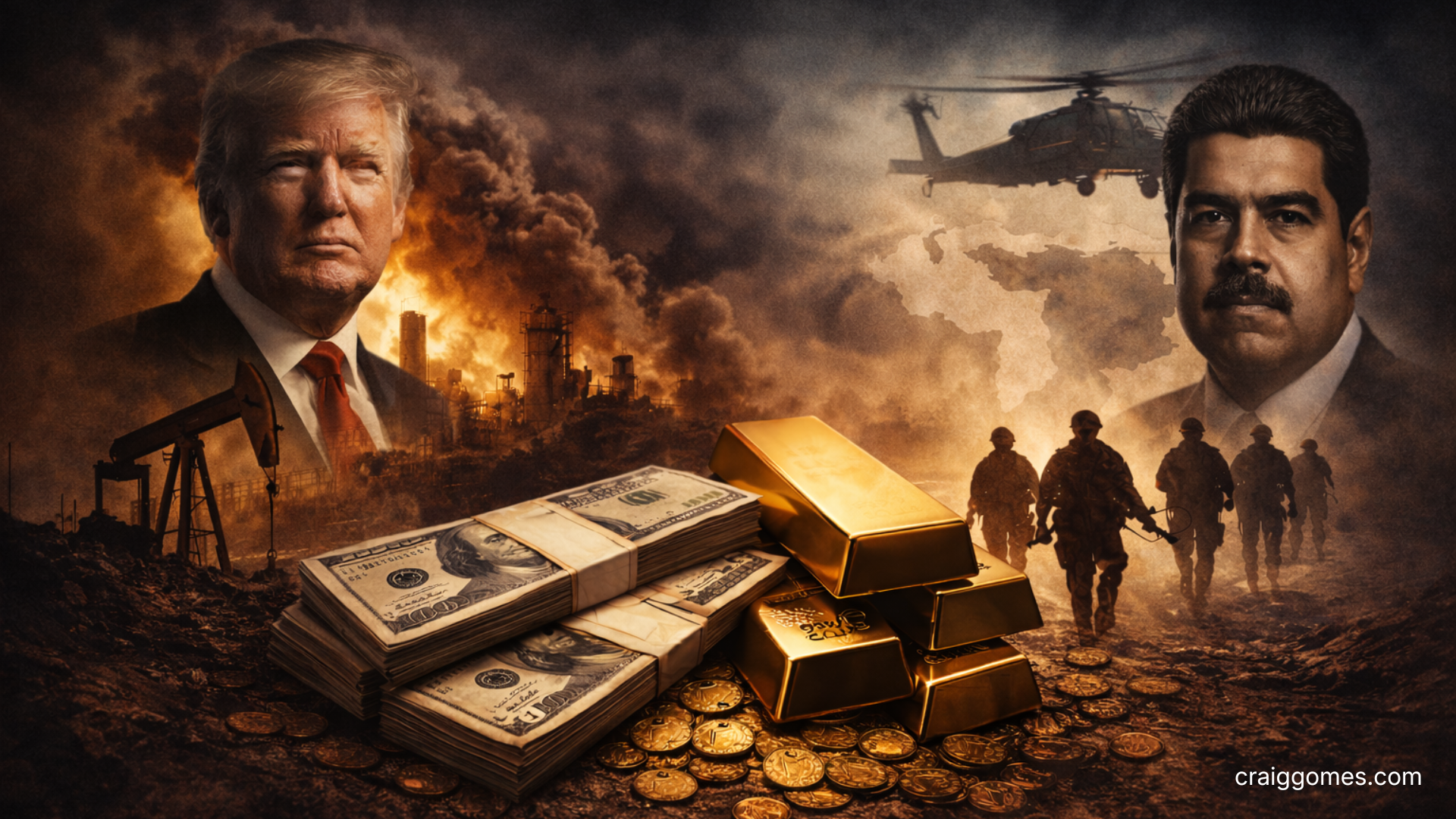
When Donald J. Trump confirmed U.S. strikes in Venezuela, and reports surfaced about pressure on Maduro’s inner circle, most reactions immediately focused on politics, crime, or personalities. That reaction is understandable, but incomplete. Events like these rarely begin with ideology. They begin much earlier, in places most people aren’t watching, inside financial systems that quietly determine who has leverage and who doesn’t.
This pattern has played out before. In 2000, Saddam Hussein announced that Iraq would begin selling oil in euros instead of U.S. dollars. To the public, it sounded like a minor accounting change. In reality, it was a direct challenge to how global trade was structured. Oil had long been priced in dollars, which created constant global demand for the U.S. currency. When a major oil producer steps away from that system, it weakens the financial architecture built around it. Three years later, Iraq was invaded. No weapons of mass destruction were found, but Iraqi oil returned to being sold in dollars almost immediately. That outcome mattered more than the narrative.

This is how modern conflict actually starts. Not with bombs, but with money. The process usually begins with financial isolation. A country is sanctioned or restricted from global trade networks. Its banks lose access to international settlement systems. Insurance for exports becomes unavailable. Foreign investors pull out. As trade slows, the local currency weakens, inflation rises, and reserves begin to drain. By the time people see breaking news on television, the economic damage has already done most of the work. Military action, if it comes, often formalises what finance has already decided.
Venezuela’s situation fits this pattern closely. The country holds one of the largest proven oil reserves in the world. Oil is not just an energy source, it is a financial engine. Because oil is traded globally, the currency used to price it becomes embedded in trade, reserves, and global demand. When a country with massive oil reserves becomes cut off from dominant financial systems, especially dollar-based ones, pressure builds steadily. At first, the effects seem manageable. Over time, they compound. Eventually, the strain becomes impossible to ignore.
In the twenty-first century, power doesn’t come only from armies or weapons. It comes from systems. Payment rails decide who can transact. Trade insurance determines whose goods can move. Settlement networks decide which currencies are accepted. Reserve status determines which countries can absorb shocks and which cannot. A nation can have soldiers, aircraft, and hardware, but if its reserves are frozen, its oil shipments can’t be insured, its currency can’t settle international trades, and its banks are locked out of global payments, control becomes largely symbolic.

This is why what’s happening isn’t just about Venezuela. Other countries are paying attention because the message is clear. If your economy depends entirely on infrastructure you do not control, your sovereignty has limits. That reality explains several global shifts happening quietly at the same time. BRICS continues to expand as countries look for alternatives to existing systems. New payment networks are being developed to reduce reliance on traditional settlement rails. Trade agreements increasingly use local currencies instead of defaulting to dollars.
Gold plays a crucial role in this shift. Unlike currencies, gold has no issuer and no counterparty. It doesn’t rely on permission, networks, or political alignment to exist. When central banks increase gold reserves, it’s not speculation. It’s insurance. Gold cannot be frozen, sanctioned, or switched off by policy decisions. That’s why central banks around the world have been buying gold at record levels. It’s a signal of distrust in purely paper-based stability.
Quiet reductions in dollar exposure don’t mean the dollar is collapsing or becoming irrelevant. They mean countries are managing risk. Dependency works well until it doesn’t. When financial systems become tools of pressure, diversification becomes survival. These moves aren’t ideological statements. They are defensive strategies.

The real warning here isn’t Venezuela itself. It’s the speed at which change happens once financial pressure reaches a tipping point. For years, things feel slow, controlled, and stable. Then suddenly, they aren’t. Most people react only after certainty disappears. Those who understand how financial systems work tend to notice the strain much earlier.
History doesn’t repeat itself in identical ways, but it often follows familiar structures. When money becomes a weapon, events stop unfolding gradually. They accelerate. Ignoring those patterns doesn’t prevent the outcome. It only makes the moment feel shocking when it arrives.


Leave a Reply